What is inside
What your child sees, and what you control.
Five calm areas, always in the same order. 55 activities, from first taps to Expert. Every picture on this page is a real screen.
Meet Puddle. He shows up all over Liquid Pond.
The six areas
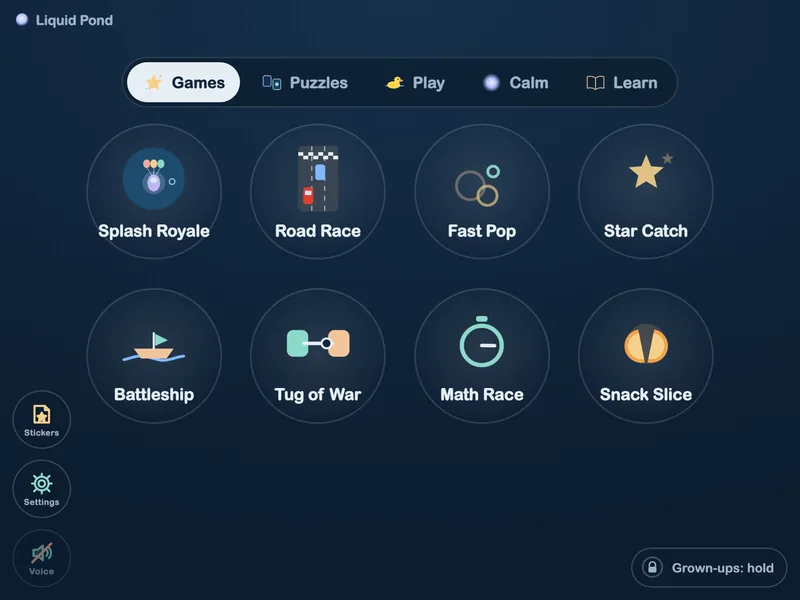
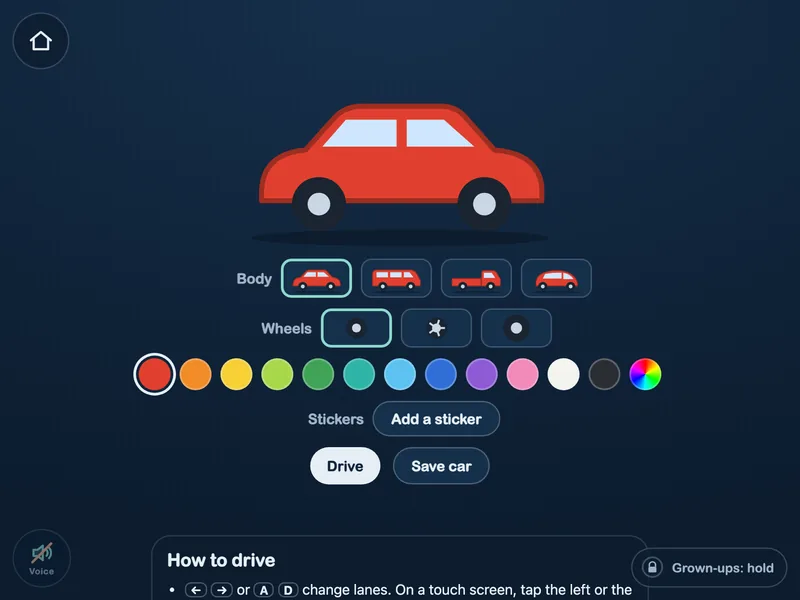
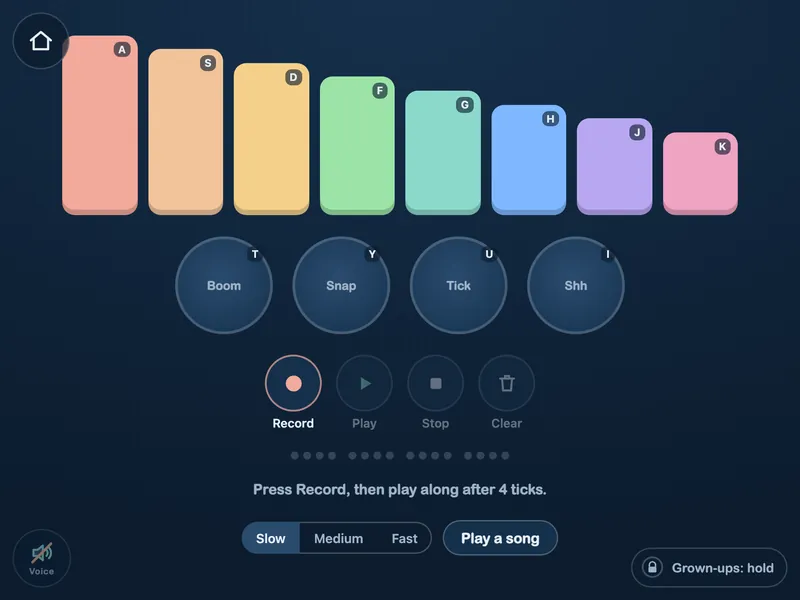

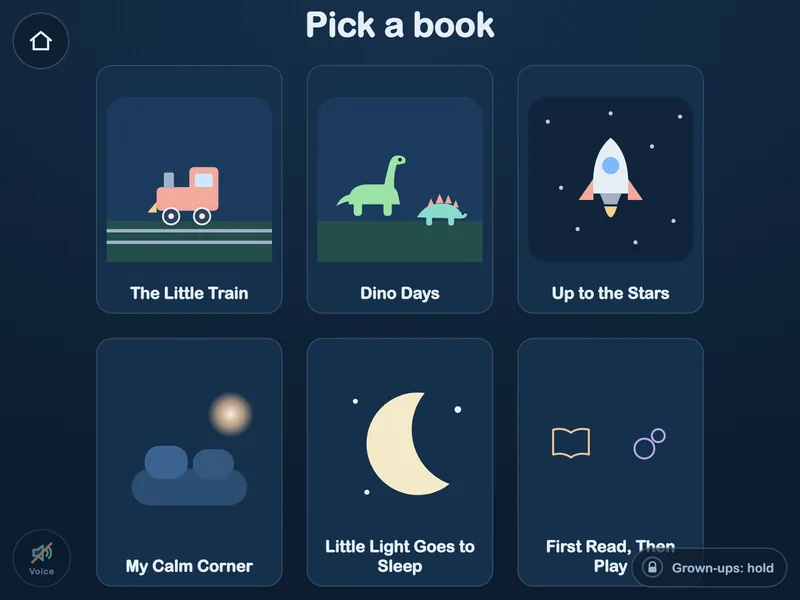
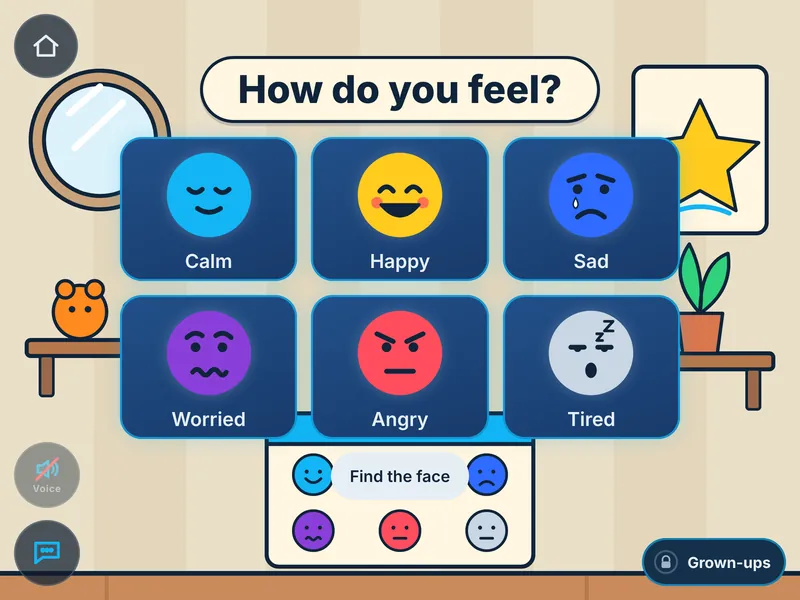
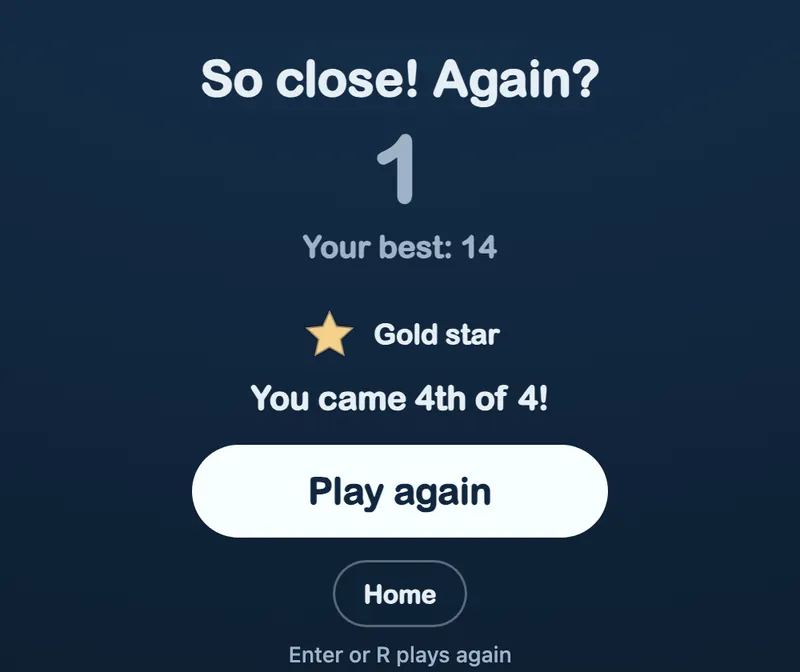
In Build, Art, Calm and Me, nothing can be lost or failed. The car race against five friendly cars is Road Race, on the Games tab, and only if your child chooses it.
What your child practices
Real skills sit inside the games. Each game adjusts to your child, round by round.
- Letter sounds and phonics
- Sound Lab: Letter and Sound, Tap the Sounds, Build the Word and Tricky Words.
- Letter tracing
- Letter Tracing, in Sound Lab. Your child follows each stroke on writing lines.
- Number tracing
- Number Tracing, 0 to 9. Each traced number shows that many of your child's favorite things.
- Letters and spelling
- Letter Board, Word Builder and Letter Train.
- Reading
- Books, read aloud in a warm, recorded voice when the voice is on.
- Step stories for daily routines
- Step stories, in Books: brushing teeth, washing hands, getting dressed, bedtime, the doctor, a haircut, waiting a turn and loud places, one step at a time. Your child taps Done after each step, so a story is a checklist too.
- Counting
- Count Up: by ones, twos, fives and tens, and backwards.
- Math
- Math, from counting to times tables, once a grown-up turns it on. Math Race, up to three-digit sums. Number Towers, for tens and ones.
- Matching and memory
- Memory and Pattern.
- Sorting
- Sort It, by color, shape and kind.
- Taking turns
- Tug of War and Battleship, two players on one screen.
- Saying words, sound by sound
- Say it with Puddle (free). Each sound lights while Puddle's beak takes its shape, he says the first sound and then the word, and your child says it back. Practice to do together, with no microphone. Speech practice to play together.
- Everyday phrases
- Phrase Pond: tap a phrase like "I need a break" or build one, and it is said out loud. A simple help, not an AAC system.
- Asking for things
- Ask Puddle. Your child taps a picture to ask for it, and Puddle hands it over.
- First, then
- In the grown-up settings, Before games puts a First, Then board on the home screen: a book or 5 math problems first, then play.
- A picture schedule for the day, and a waiting timer
- My Day. You pick the picture cards for the morning, afternoon and evening, and your child taps each one when it is done. Wait is a calm timer: a disc that shrinks over 1 to 5 minutes.
- Naming feelings
- Feelings Pond. Your child picks how they feel, and Puddle shows one calm idea that fits. Find the Face asks "Which face is happy?"
- Calming down
- Breathe, a slow breathing guide that is always open.
From first taps to Expert
Every scored game has 20 levels: Easy 1 to 5, Medium 6 to 10, Hard 11 to 15, Expert 16 to 20. Math runs from counting to times tables, and Math Race goes on to three-digit sums.
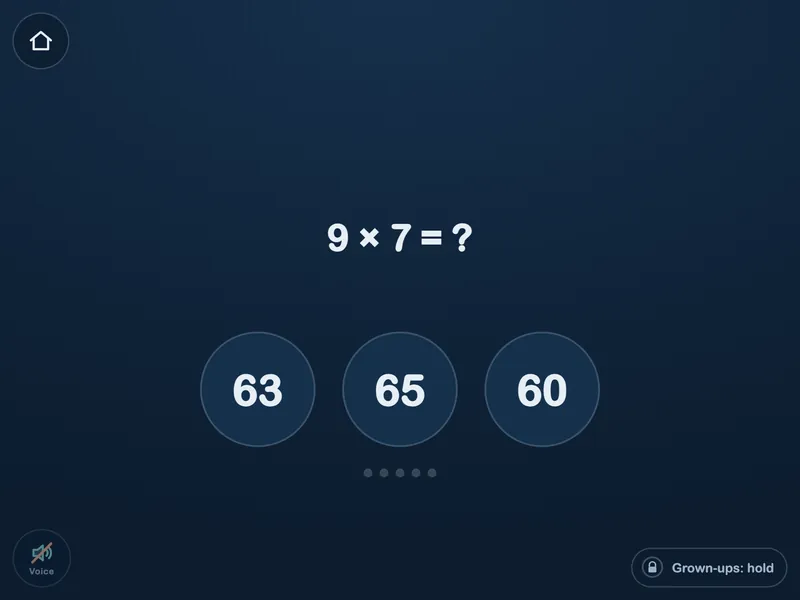
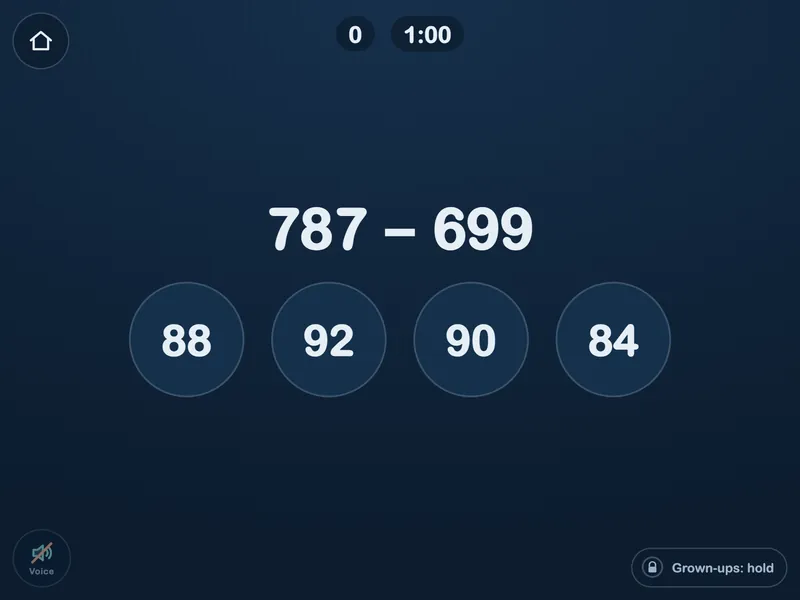
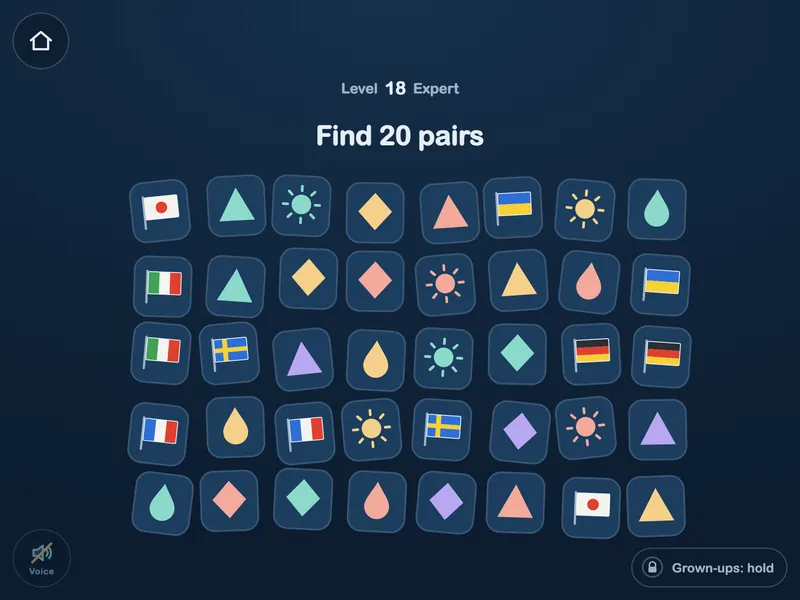
The look is the same calm, dark screen at every level, for a young child, a teen or an adult.
Their favorite things, everywhere
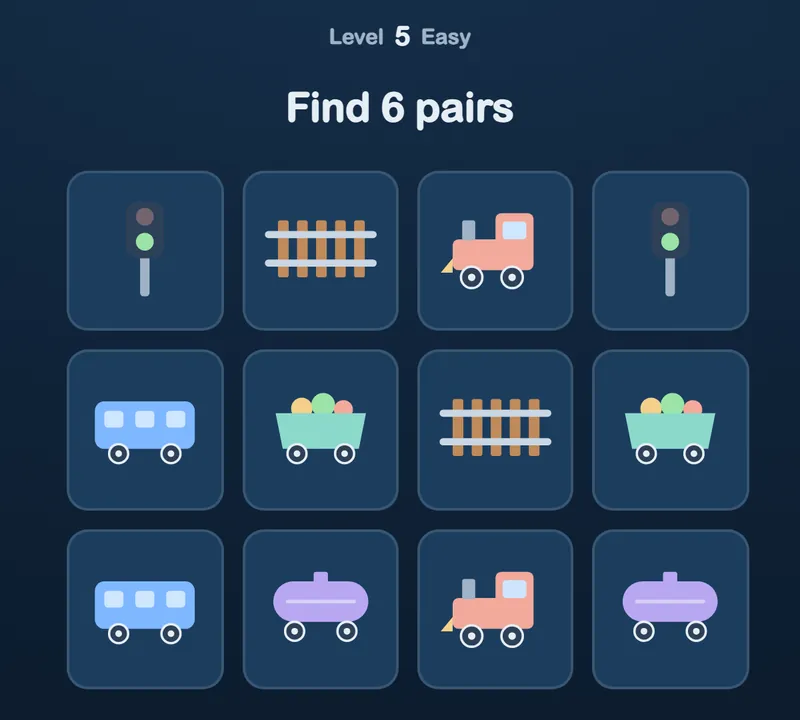
Pick up to 3 of 12: trains, cars, dinosaurs, space, animals, ocean, flags, letters, numbers, bugs, food and weather. You can also add a word they love, for the spelling games. Tap one to see the real Memory game change.
Memory, Sort It, Math Race, Star Catch, Fast Pop, the Letter Board and a book change to match. Favorite things never have to be earned. One is free, and Plus gives up to 3.
Gentle by design
Most apps for children are built to hold attention for as long as possible. This one is built to be calm.
- Quiet to start. A new child hears only soft water drops and pops. No music, and the reading voice stays off until you turn it on.
- No buzzers, no red X. A close round says "So close! Again?" Games have 3 hearts by default, and Peaceful mode turns hearts and Game over off.
- Always the right challenge. Each game adjusts to your child, round by round. Or switch on "Ask before changing" and Puddle asks "Want a harder one?" first.
- The same place every time. Five areas, always in the same order.
- No speech or reading needed. Buttons show pictures, and with the voice on, every screen reads aloud in a warm, recorded voice.
- A way to say "I need a break". Talk buttons such as "I need a break", "I need help" and "All done". They are a simple help inside the games, not an AAC system.
- You set the rules. Activities, time, levels, sound and speed, behind a PIN.
What you control
None of this is needed to start. Open the games and press play. When you want to change something, hold the Grown-ups button in the corner of the games. The first time, you pick a PIN of 4 numbers. If you forget it, "Forgot PIN?" lets you pick again after a grown-up math question.
Which activities appear
Switch any activity on or off. Leave one on if your child does better with a single choice.
Play time
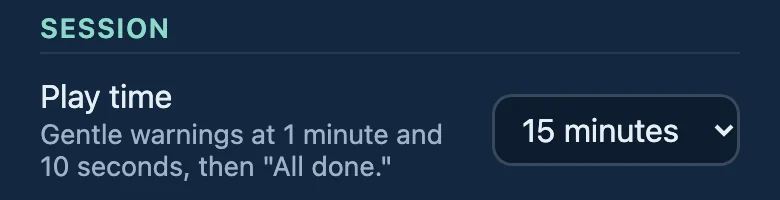
5 to 30 minutes, or no limit. Warnings come at one minute and ten seconds, then a quiet "All done".
Difficulty
Set each game's level by hand, let it follow your child's age, or let Puddle ask your child between rounds.
Sound and motion
A natural reading voice with captions, sound effects, calmer colors, less motion, bigger buttons, and a slower speed for every moving thing.
Before games
Play anytime, a book first, five math problems first, or a book and then math. It is off until you turn it on.
One profile per child
Each child keeps their own name, level, settings and best scores. You can see minutes played and days played this week.
About my child
Tell us how your child plays, and we set things up to fit them: sounds, button size, time, and which games come first. Twelve plain questions, all skippable. Your answers stay on this device, and you can change or erase them any time.
My Day
A picture schedule for the day, and a waiting timer. You pick the picture cards for each part of the day. Your child ticks them off, and Wait shows a disc that shrinks over 1 to 5 minutes.
More questions parents ask
Short, plain answers. Four more are on the home page. If yours is not here, tell us.
How does play end?
Set a play time in the grown-up area. Your child gets a warning with one minute left, another with ten seconds left, then a calm goodbye: Puddle waves, breathes once with your child and shows what comes next.
Is more screen time a good idea?
That is your call, and you know your child. Many autistic children use a screen to unwind. Liquid Pond is made to be a calm break with a clear end.
What ages does it suit?
Liquid Pond is made for children aged 3 to 12. Older kids, teens and adults use it too. Press and hold the Grown-ups button in the corner of the games. In Sound & look, set Look to Older: darker and plainer, with no confetti, and levels read as skills. In Games, set Challenge level to Expert for the hardest of the 20 levels.
Will my child get bored?
There are 55 activities. Every scored game has 20 levels, and there are 12 favorite things to switch between. What families tell us helps decide what we build next.
Does it help with speech and words?
Say it with Puddle is free speech practice to play together: each sound lights while Puddle's beak takes its shape, he says the first sound and then the word, and your child says it back. Phrase Pond and the talk buttons say phrases like "I need a break" out loud. It is practice at home, not speech therapy. Speech practice to play together.
What can my child learn as they grow?
Reading goes from letter sounds and tracing to building words and tricky words. Math goes from counting to three-digit sums and times tables. Every scored game has 20 levels, up to Expert, and adjusts after each round. Feelings Pond, step stories and My Day cover feelings and daily routines.
Is progress saved across devices?
Not yet. Today, levels, settings and progress stay on the device your child plays on. A second tablet or another browser starts fresh. We are testing a way to carry progress between devices. It is not switched on yet.
On an iPad or iPhone, how do I keep my child's progress?
Play from a Liquid Pond icon on the Home Screen. In Safari, tap Share, then Add to Home Screen, then Add. Safari may clear what a website saves when it has not been opened for about a week, and the icon keeps its own copy. It is not an install. Set up your child from the icon: what you set up in Safari stays in Safari.
For teachers, therapists and clinics
For your classroom
- No student accounts. Nothing to install.
- $59 a year for one teacher. $399 for a whole building.
- Facts to show your principal, and a free 8-week pilot.
For the families you see
- It does not replace therapy or an AAC system.
- 30 activities are free for good, with no sign-up and no card. Plus opens all 55 activities for $39.99 a year, and you can try it 7 days with no card.
- $149 a year for a clinic of up to 5.
Two ideas we took from research
- Build around a child's own interests. Dunst, Trivette and Hamby, 2012: a meta-analysis of 24 small studies with 78 autistic children aged 2 to 6 found that building early intervention around a child's own interests increased positive social behavior and reduced challenging behavior. Read the paper
- Aim for about 7 in 10 right. Shohieb, Doenyas and Elhady, 2022: in a study of a vocabulary game for autistic children, the version that adjusted difficulty so each child won about 7 in 10 times reported about 88% higher engagement than fixed levels. Read the paper
These were small studies. The first looked at teaching and therapy sessions, not games. Neither one tested Liquid Pond. We use them as a starting point, not as proof. The quiet start, the warnings and the choice to have Puddle ask before a change are our own rules.
About 1 in 31 eight-year-olds in the communities the CDC tracks had been identified as autistic in 2022. In 2020 it was 1 in 36. Source: CDC ADDM Network, 16 sites, 2022 data, published April 2025.
What Liquid Pond is not
- It does not replace therapy, school or time with you. It is a calm activity.
- The talk buttons (such as "I need a break" and "I need help") are not an AAC system, and do not replace one.
- It has not been tested in a study of its own. The two ideas we took from research are on this page, with their limits.