Speech practice games to play together
Say it with Puddle, the talk buttons and letter games: speech practice to sit down and play with your child, made with these needs in mind.
Many ways to talk
Autistic children talk in many ways. Some use lots of words. Some repeat words and phrases they have heard. Some use few or none: about 30% of autistic children remain minimally verbal, a 2013 review estimates. Every one of them deserves a patient partner and a calm place to try.
Liquid Pond is practice and play for a grown-up and a child to do together. Your child's speech-language pathologist knows your child's goals. Show them what you play, and ask which sounds and words to practice.
Say it with Puddle
Puddle stands next to a picture card on a little easel. Under it, the word is split into its sounds, like u and p, each with a small mark for the shape the lips make. Each sound lights in turn while Puddle's beak takes its shape: closed for b, p and m, wide for ah, round for oh. Puddle says the first sound, then the whole word ("bah... ball"), all in his own voice. Then he says the whole word, and then "Your turn!"
Your child says it, and a tap on "I said it!" gets a cheer and a star. There is never a score and never a wrong answer. With no tap, Puddle moves on gently. About five words make a round, then a calm All done.
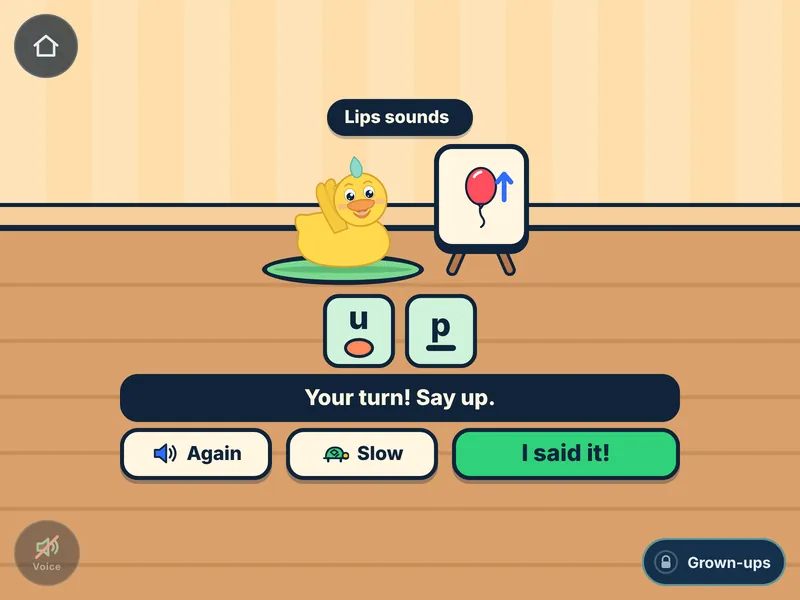
- Again and Slow: hear the word again, or with each sound held longer.
- Start with: Lips sounds (b, p, m), Big vowels (ah, oh, oo, ee), Short words, Words they love, from your child's favorite things, or Asks from Phrase Pond.
- Speed: Normal, Slow or Extra slow.
- Puddle waits: 3 seconds, 5 seconds, or until a tap.
- Your own words: type up to 12 in the grown-up area, such as the words your child's speech-language pathologist is working on, and Puddle practices those first. They stay on this device.
- It never listens. No microphone, no recording, nothing sent anywhere.
Say it with Puddle is in the Learn tab, and free for everyone.
The talk buttons
A speech bubble button sits in the corner of the screen. A tap opens six talk buttons: "I need a break.", "Let’s play more.", "All done.", "I need help.", "I feel happy." and "I want a hug." A tap on one says it out loud, even with the read-aloud voice off. They are on from the start, and free.
The talk buttons are not an AAC system, and they do not replace one. A child who uses an AAC device keeps it beside them while they play.
Phrase Pond
Lily pads with whole phrases to tap and hear, like "Too loud right now." and "Help, please.", plus one for each favorite thing, such as "Let's go see the fast train!" Build a phrase puts one together in two taps: how it starts, "I need...", then how it ends, "a break." You add up to 8 phrases of your own in the grown-up area. Phrase Pond is part of Plus. A child gets one try of a Plus game each day.
Letter and word games
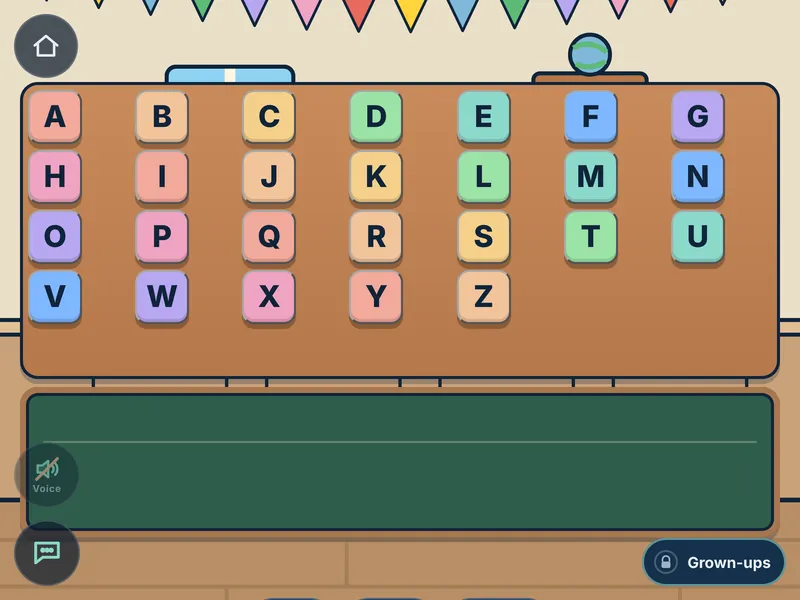
- Letter Board (free): pull letters down onto a line, then tap Say it to hear each letter and then the whole word. A faint picture in each empty slot shows a word starting with its letter.
- Sound Lab (first game free): in Letter and Sound, look at the letter, listen to its sound, then tap the picture starting with it. Tap the Sounds, Build the Word and Tricky Words are in Plus.
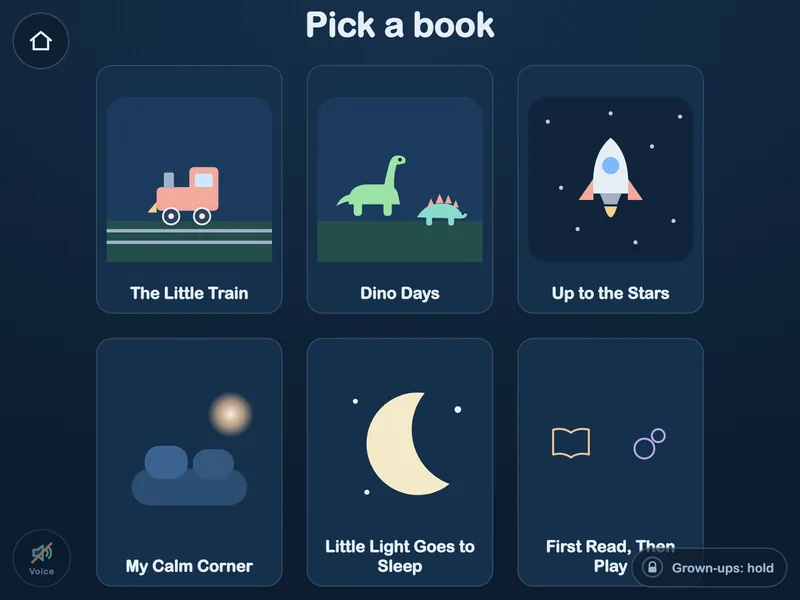
- Books (three free): picture books, read aloud with Read aloud on.
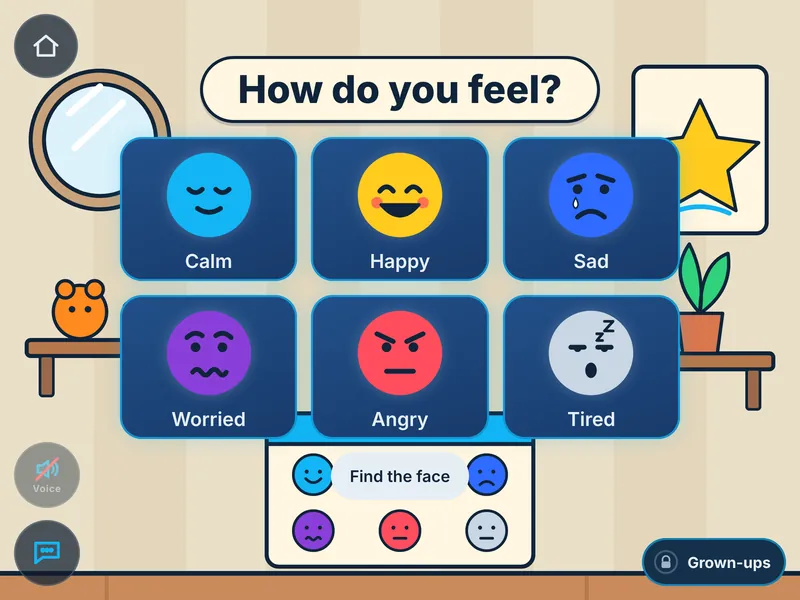
- Feelings Pond (free): tap how you feel, and Puddle shows one calm idea. Then a game: find the face.
- Word Builder (Plus): look at the picture, or tap it to hear the word, then tap the letters in order to spell it.
Open only the five free ones, for this visit on this device.
How to practice together
- Sit side by side. Hold the tablet between you, so your child sees your face and Puddle's beak.
- Pick a few words. Five a day is plenty. Use the words your child's speech-language pathologist names.
- Say it with Puddle. Say the word along with him, then wait. Give your child time.
- Every try counts. A sound, a sign, a picture or a word. Tap "I said it!" and cheer.
- Stop while it is fun. A short round on a good day beats a long one on a hard day.
- Carry it into the day. Say the same words at snack, in the bath and on the way out the door.
Bring it to your child's speech-language pathologist
Tell them what you play and which words you practice. Ask which sounds to start with, how long to wait, and which words matter most at home. Our page for clinics and teachers shows how they use Liquid Pond in a session.
Liquid Pond is made with these needs in mind. It is practice and play, not a plan of care. Every child is different, and your child's speech-language pathologist sets the goals.
Sources
- Tager-Flusberg H, Kasari C. Minimally verbal school-aged children with autism spectrum disorder: the neglected end of the spectrum. Autism Research 6(6), December 2013. About 30% of autistic children remain minimally verbal. Read the summary
- Centers for Disease Control and Prevention. Signs and symptoms of autism spectrum disorder. Lists delayed language skills, and repeating words or phrases over and over (echolalia). Last reviewed 5/16/2024. Read the page
Printables to go with it
The free alphabet cards have one large letter on each card, to match the Letter Board on screen. The free calm-down card pack has picture cards for a break, a squeeze and calm music.
See the printables, three free and one kit for $9.
Try it now
Liquid Pond has 55 calm games and activities with Puddle the duck. 30 activities are free for good, with no sign-up and no card. Nothing to install.
Play nowMore from Liquid Pond: all guides, printables, and what is inside.